


What We Do
What's a "ceilidh", anyway?
"Ceilidh" ("kay-lee") is a Gaelic word originally meaning a social gathering or party. Over time, especially in England, it's come to mean an event that definitely includes dancing, and it's is the continuation of a long tradition of dances in village halls and big private houses (or "barn dances"). The modern " English ceilidh" especially emphasises simple dances that don't require any previous experience.
 What makes it different from most other sorts of musical entertainment
is the caller - the MC who teaches you the dances so you don't need
to be an expert before you take to the dance floor. There are set
dances, circle dances, couple dances, dances where you change
partners and dances where you don't. It's easy and fun: we don't do
difficult dances unless we're sure you're all experts!
What makes it different from most other sorts of musical entertainment
is the caller - the MC who teaches you the dances so you don't need
to be an expert before you take to the dance floor. There are set
dances, circle dances, couple dances, dances where you change
partners and dances where you don't. It's easy and fun: we don't do
difficult dances unless we're sure you're all experts!
A Ceilidh with Fendragon
For the music, we pick tunes that have the right sort of lively bounce to get you up and dancing, and choose the right music and speed to suit each dance perfectly and tell your feet where to go. We play mostly traditional English tunes that have evolved over the years to be perfect for this type of dancing.
 We work with several callers on a regular basis, and will provide
one as part of the package or work with the caller of your choice.
We work with several callers on a regular basis, and will provide
one as part of the package or work with the caller of your choice.
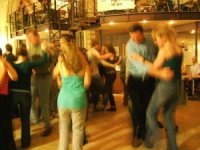
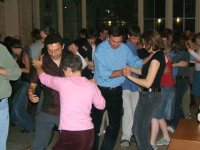
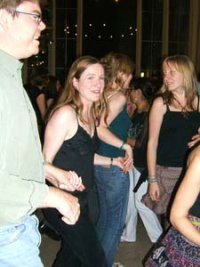
We play for birthdays, anniversaries, weddings, fundraisers, office and club parties, public ceilidhs - any excuse to have a good time, in fact. The pictures on this page were taken from an Amnesty International ceilidh where we played in 2005.
What You Provide
- 13 amp power point less than 10m from band.
- A space for the band and caller (3m x 5m recommended.)
- A room full of people ready to have fun and not take themselves too seriously for an hour or three.
- Some liquid refreshment isn't a bad idea too! You'll probably want to organise a break in the evening, and maybe serve food - but that's all up to you.
What We Provide
- Band
- Caller
- All necessary sound amplification equipment
- Typically two sets each of up to 90 minutes of dancing, with a break in the middle if the total dancing time is two hours or more
- If it's a public event for which tickets can be purchased, we can put contact details on the gigs page of our web site and promote in other ways if possible.
Photos from
Amnesty
International
For an alternative view of what an "English Ceilidh" is, see this not-so-serious description